/eh/2025-01-08/173633966714069467/picture.png)

/eh/2024-12-24/173503345348979036/Favorite-Icon.png)
/eh/2025-07-08/1751962110204480194/picture.png)
/eh/2025-06-21/1750485478958537574/countryInfoIcon.png)
/eh/2025-06-21/1750485741321434291/Hi-Sign-in-My-Nihao.png)
/eh/2025-06-21/1750485837193896318/cart.png)
/eh/2025-06-21/1750485968202533847/cart.png)
/eh/2025-04-17/1744862476612819675/hot-img.png)
/eh/2025-11-07/1762504524550532584/header-icon.jpg)
/eh/2025-07-07/1751875582852206790/header-icon.png)
/eh/2025-07-07/1751875587886277738/header-icon.png)

Best in 7 days


Shopping security
This package for $234.00 comes with
Made out of aircraft grade aluminum and hard anodized to resist scratching.
Weighs about 20 ounces.
Runs on 1 21700 Protected battery.
About 9 inches long in flood beam and about 10 inches long in spot beam.
Head is about 2.75 inches across with a 30mm body/tube.
Lumens, Red = 400, Green = 1150, White = 1000.
Run time for Red, Green White = 2.5 hours at full power. Run time for IR 850nm and IR 940nm = 1 hour 50 minutes with no dimming the entire time. Turn the power down just a little and you will get much longer run times.
Will clear all scopes objectives up to 60mm with our Predator Pro mount.
5 year warranty on light housing and light module. 2 year warranty on any tail caps and switches, 1 year on batteries and charger.
The Hyperion 40, 50 and 66 Lights are the same power and light output as our extremely popular and farthest shining light, the Coyote Cannon light.
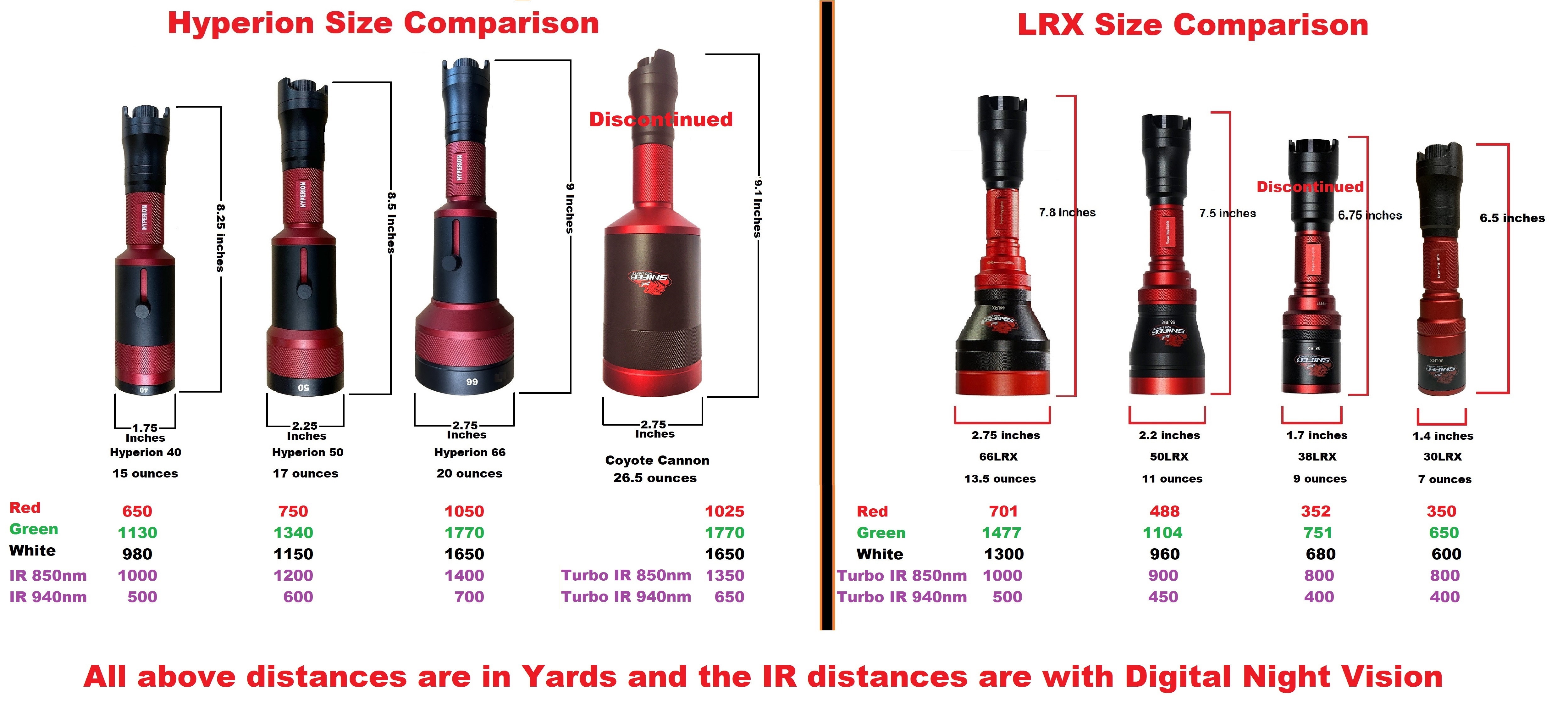
The Hyperion 66 not only has the same light output as the Coyote Cannon but it will shine a touch farther and that includes in IR 850nm and IR 940nm compared to the Coyote Cannon with Turbo IR 850nm and Turbo IR 940nm. The Hyperion 66 weighs about 6.5 ounces less than and is overall smaller than the Coyote Cannon.
The Hyperion 50 has the same light output as the Hyperion 66 but it will not shine as far because it has a bigger spot beam. The Hyperion 50 is brighter than our popular 66LRX in all colors including Turbo IR 850nm and Turbo IR 940nm.
The Hyperion 40 has the same light output as the Hyperion 66 and 50 but it will not shine as far because it has a bigger spot beam. The Hyperion 40 has more light output than our 66LRX light and will shine just a little less distance than the 66LRX light in all colors although the IR 850nm and IR 940nm in the Hyperion 40 will shine a touch farther than the 66LRX in Turbo IR 850nm and Turbo 940nm.
The Hyperion lights are all interchangeable with each other. What this means is all the tail caps, Light modules and heads are interchangeable between the lights. This means if you have our Hyperion 40 and later on decide you would like to see farther, you can simply buy the Hyperion 66 head and covert your light to the Hyperion 66 to see farther. All the tail caps for the Coyote Cannon will work with the Hyperion and all the Hyperion tail caps will work with Coyote Cannon. ONLY the tail caps are interchangeable between the Hyperion and Cannon, no other parts are interchangeable.
Please note that all the IR 850nm and IR 940nm for our new Hyperion lights are Turbo IR even though they don't say Turbo. We do not have our normal IR 850nm and IR 940nm for our Hyperion Lights.
The difference between the Turbo IR and the normal IR is all our lights will focus the Turbo IR to a smaller spot beam allowing the user to see much further. You also get a much better digital picture out of your digital night vision scope with the turbo IR than you will with the normal IR.
Please note that Turbo IR 850 is much brighter and shines further than Turbo IR 940nm just like the the normal IR 850nm is much brighter and shines further than the normal IR 940nm.
When you put the Turbo IR 850nm in our 30LRX light, it will make it shine almost as far as our much bigger Coyote Cannon light with the normal IR 850nm.
Please note that the Turbo IR with our Coyote Cannon, 66LRX, 50LRX lights will not fill the entire scope screen on 2 power scopes on the base magnification like the Wraith HD/4K mini 2X unless you zoom the scope in some. The 50LRX Turbo IR may not fill the entire scope screen on some 3.5 power scopes on the base magnification but it will be very close to filling the entire scope screen. This is due to the variances between lights and scopes.
All our new Hyperion lights will easily flood enough to fill scopes with a base magnification of 2 power.
Our new Hyperion 66 IR 850nm will shine a touch farther than the Coyote Cannon Turbo IR 850nm. The Hyperion 50 and 40 IR 850nm will shine farther than our 30LRX, 38LRX, 50LRX and 66LRX with Turbo IR 850nm.
We are probably the only company that sells IR hunting lights that has a meter to measure the intensity of IR light. Now the intensity will never tell you how far the light will shine but the higher the intensity is, the further the light will shine. For example, all our lights with the Turbo IR will put out about 3-5 times the intensity than it does with the normal IR. No this doesn't mean you will see 3-5 times as far, but you will be able to see further. How much further is impossible for us to say because there are just too many variables that are in play for us to say. One of the big advantages is the turbo IR 850nm will now allow users to use a much smaller light to see the same distance as bigger lights or continue to use the same light to see further with the new Turbo IR.
Run time with the Turbo IR is just shy of two hours and the light will be just as bright at 1:45 as it was when you first turned it on with a fully charged battery. The normal IR run time is about 2.5 hours but it will dim the entire life of the battery and will only be at about 60% brightness at 2 hours. This means you get a longer useful runtime out of the out of the turbo IR because most hunters will usually swap to a fully charge battery after 1.5 hours when using the normal IR so they can have a brighter light.
Again, all our Hyperion lights IR are Turbo IR we just don't list them as Turbo since we don't have the normal IR for them.
It really depends on how big and heavy of a light your willing to use and how far you want to be able to see. Me personally, I'm going with the Hyperion 66 because I don't care about the size and weight, I just want the brightest and farthest shining light possible. If I did care about weight and size, I would go with the Hyperion 40 or go really small and light weight and go with the 30LRX. Below you will find a chart with all the sizes, weight and distance each light shines in each color.
Please note that we use the ANSI/NEMA FL-1 system to determine the Candela and Distance of all our lights as this is becoming the Industry standard. We have yet to see any of our competitors that sell mainly hunting lights use the ANSI system. We feel this is because they don't want to give you a even comparison with their lights to ours because they just can't compete with our lights. If they did use it, you will easily be able to see how much further our lights shine.
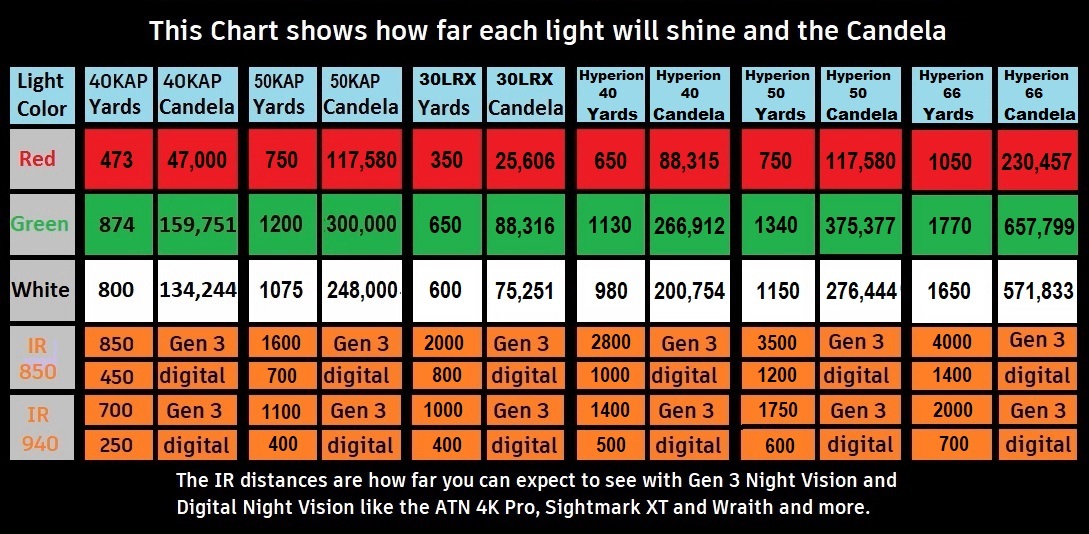
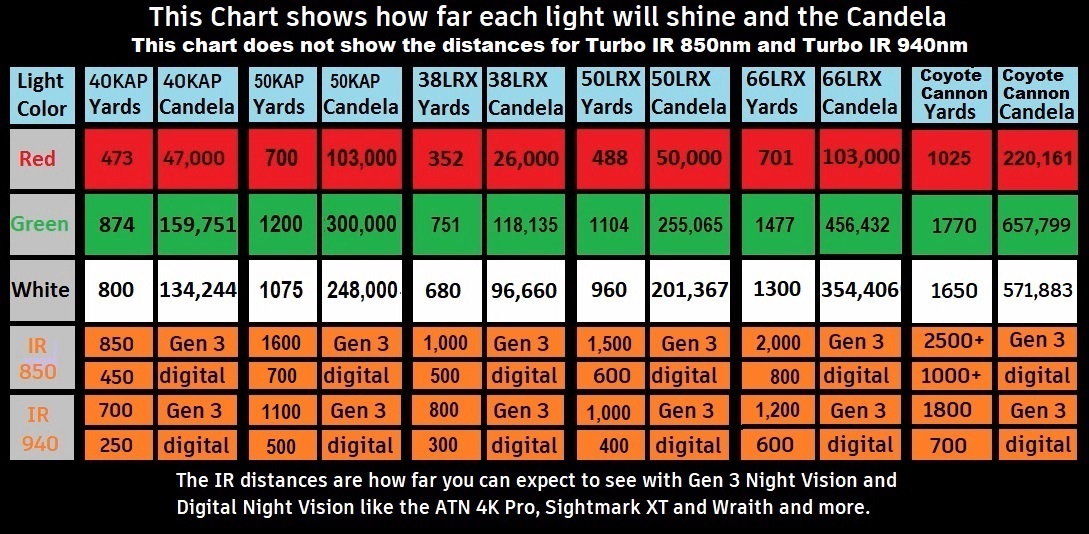
Please note that while our lights will shine the distances we give below, the distances you can actually see the entire animal is going to be less but they will light up the animals eye's past the distances we give below. The reason for this is because Humidity, rain, clarity of the air, how well your scope does in low light and other conditions will all effect how far you can see to Identify and the yardage numbers below are in perfect controlled conditions. Any company that lists a specific number on how far you can identify animals with their lights is just throwing numbers at you because there is no way they can know because they don't have your eyesight, they don't have your scope and they are not hunting in the same conditions you are. This is why we list the distance our lights shine and the Candela because they are both facts, not some made up numbers. As a general rule of thumb, you will be able to identify at about 1/2 to 2/3 the distance a light shines depending on your equipment and field conditions. For example, if a light shines 600 yards, you should be able to identify somewhere between 300 and 400 yards. The first chart below is the current minimum distances our lights will shine in spot beam with a fully charged battery. The second chart is our older lights and how far they will shine with the LED modules that came with them.
On August 18, 2009, the American National Standards Institute (ANSI) approved a new specification standardizing flashlight performance. The standard was developed by the Flashlight Standards Committee of the National Electrical Manufacturers Association (NEMA). The committee consisted of a number of flashlight manufacturers. The resulting specification is called ANSI/NEMA FL-1. As with many technical specifications, the full standard can only be purchased from ANSI or NEMA.
The purpose of the standard is to allow consumers to make apples-to-apples comparisons of lights and to eliminate exaggerated light performance. The tests can be performed by the manufacturer or an independent lab. The necessary equipment and calibration makes this an expensive undertaking.
Here is information that is known from public sources. Performance of flashlights is measured using new batteries included with the light when purchased or, if no batteries are included, the batteries recommended by the packaging. There are six criteria used:
Total lumens of output, measured in an integrating sphere after the light has been on for 30-120 seconds. 30 seconds gives a little time for the LED to get hot and the battery voltage to sag which will usually result in a lower output number.
The amount of continuous runtime (in minutes) until the light output drops to 10% of its original value (measured 30 seconds after turning the light on).
This test is done using the batteries included with the flashlight. If no batteries are included, the test is done using the manufacturer-recommended batteries.
The test is done in an integrating sphere just like the lumen test with light output measured every 15 minutes. 10% of brightness probably gives inflated runtime numbers. In the past, some testers used 50% to be a little more practical, but with most batteries, the drop-off is usually pretty quick and the time between 50% and 10% usually is not long.
Light intensity in candela (cd) at the brightest part of the beam. A lux reading in the brightest portion of the beam is taken at some distance (2m, 10m, or 30m) with the light on its brightest mode and tightest focus at some time between 30 and 120 seconds of turning the light on. The lux reading is multiplied by the square of the distance in meters to get candela. Regardless of the distance at which the reading is taken, you should end up with the same value in candela, therefore the measurement is independent of distance. A lux reading taken at 1 meter distance is the same as candela (since 1 squared is 1).
The distance in meters at which the flashlight produces a light intensity of 0.25 lux. This is not very bright, about equal to a full moon. This distance is not actually measured. Instead the value is calculated by taking the peak beam intensity measured above, dividing by 0.25 lux, and taking the square root of the result. For example, the Sniper Hog Lights 66LRX with a Red LED has a peak beam intensity of 103,000 Candela. Divide this by 0.25 to get 412,000. Now take the square root to get 641.87. Now if we round that up it comes out to 642 meters or 702 yards.
There are three possible ratings:
IPX4 "Water resistant" Light can be splashed with water from all directions without water getting inside.
IPX7 "Water proof" The light can be submerged in 1 meter of water for 30 minutes. Water can leak into the light, but not into areas with electronics or batteries. The light must still operate when removed from the water and then is tested again 30 minutes after being removed.
IPX8 "Submersible" The light can be submerged for 4 hours to some depth greater than 1 meter. The depth would be specified, e.g. IPX8 10 meters. Realistically the light is not put in the given depth of water, but instead is completely submerged in a container and the pressure is then increased to simulate the depth.
Height, in meters, from which the light (including batteries) can be dropped onto concrete without cracking or breaking and still function. Lights are dropped while in the Off position and allowed to come to rest before inspecting for damage. For ratings over 1 meter, each sample light is dropped six times with different faces towards the ground.
Export of Thermal Imaging Equipment or related accessories (such as manuals) is strictly regulated by the US Department of State in accordance with the guidelines of the International Traffic in Arms Regulations (ITAR). It is a major crime to ship or carry US manufactured thermal imaging devices outside the borders of the United States, punishable by fines and prison sentences. Ignorance of these regulations will not hold up in court. By purchasing thermal imaging equipment from Thermal Optics Plus, you attest that you will not attempt to export or carry this thermal imaging equipment outside the borders of the United States. Also, it is illegal to allow a non-US Citizen to look through US Thermal Imaging Equipment, even on US soil. Again, this is a crime punishable by fines and prison sentences.
Ships within 48 hours · Estimated delivery Sep 27 - Oct 2
US$40
Get nowSign up to your membership to get coupons up to
15%
Get nowOpportunity to enjoy order discount up to 15% off
Top-Converting Item to Boost Your Average Order


