/eh/2025-01-08/173633966714069467/picture.png)

/eh/2024-12-24/173503345348979036/Favorite-Icon.png)
/eh/2025-07-08/1751962110204480194/picture.png)
/eh/2025-06-21/1750485478958537574/countryInfoIcon.png)
/eh/2025-06-21/1750485741321434291/Hi-Sign-in-My-Nihao.png)
/eh/2025-06-21/1750485837193896318/cart.png)
/eh/2025-06-21/1750485968202533847/cart.png)
/eh/2025-04-17/1744862476612819675/hot-img.png)
/eh/2025-11-07/1762504524550532584/header-icon.jpg)
/eh/2025-07-07/1751875582852206790/header-icon.png)
/eh/2025-07-07/1751875587886277738/header-icon.png)

Best in 7 days


Shopping security
Active ingredients in SYNAPTAID® include Lion’s Mane mushroom, lithium orotate, folate, vitamin B6, vitamin B12, iodine and vitamin D. Learn more about each of these agents and the evidence for their role in brain health below.
Animal studies show that Lion’s Mane has the ability to stimulate regeneration of brain cells – specifically in a part of the brain called the ‘hippocampus’ [3]. The hippocampus is involved in functions such as memory and orientation, and it’s the part of the brain usually most affected in cognitive impairment and Alzheimer’s disease.
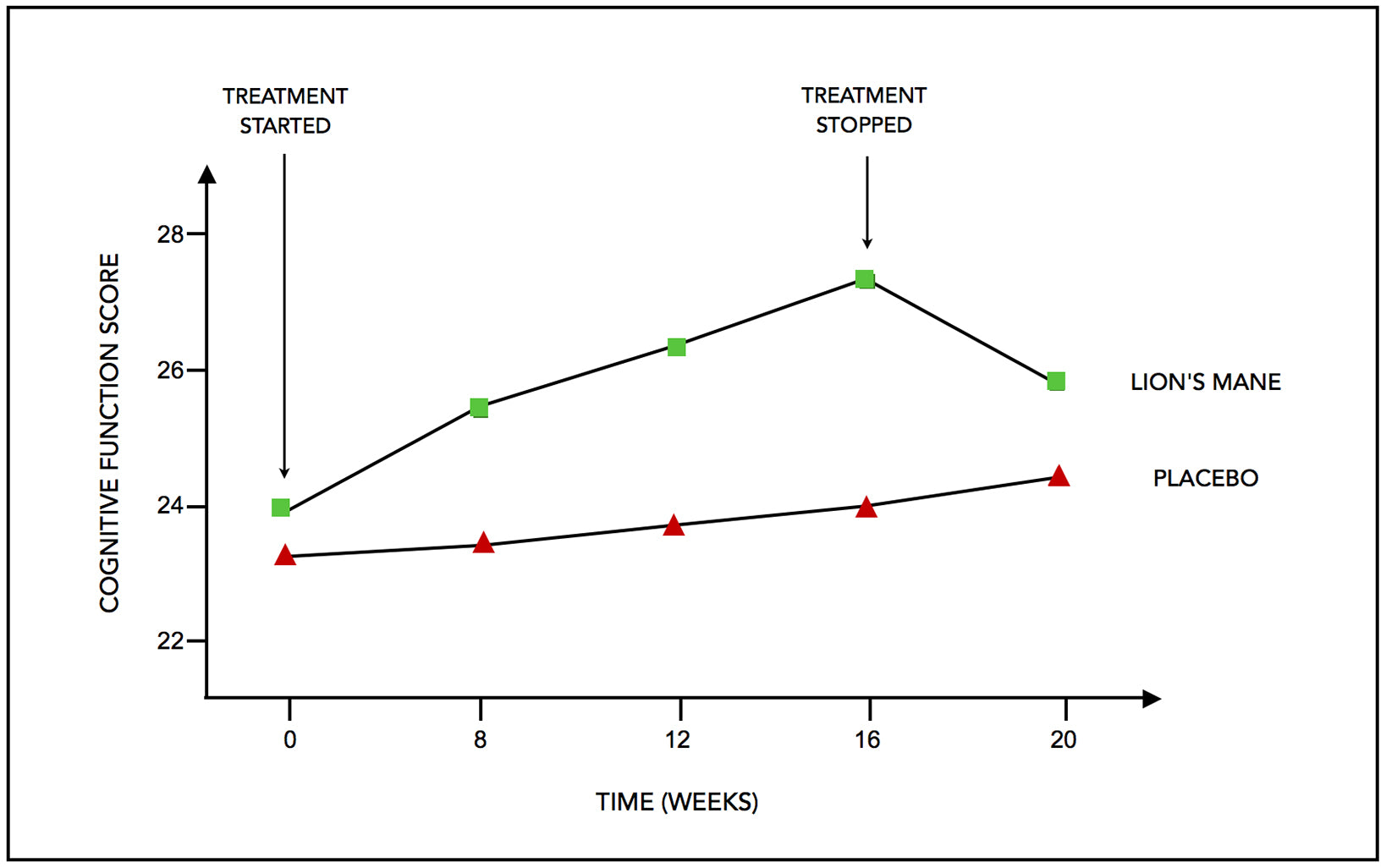
In a double-blind, placebo-controlled study in adults diagnosed with ‘mild cognitive impairment’, Lion’s Mane mushroom was found to significantly improve cognitive function [4]. This landmark study showed that cognitive function increased steadily over the 16 weeks study subjects took Lion’s Mane. The supplement was then stopped, after which there was decline in cognitive function over the next four weeks (see figure below).
Lithium is perhaps most well-known for its use as a drug to treat ‘bipolar disorder’. Lithium, though, is in fact an essential mineral (in the same chemical group as sodium and potassium), and research shows it can have profound benefits for the brain, but at dosages that are a fraction of those used conventionally. In psychiatry, lithium is used in carbonate form and at dosages are usually in the order of 75-350 mg of elemental lithium per day. In contrast, when using lithium as a nutrient, rather than a drug, it is usually used in orotate form, and in dosages ranging from just 5-15 mg per day.
Lithium has wide-ranging neurophysiological effects in the brain, including an ability to boost BDNF levels [5], and anti-inflammatory effects [6]. This latter action is relevant as inflammation has been identified as common underlying factor in cognitive impairment and dementia.
Another of lithium’s actions is to inhibit the enzyme GSK-3 (glycogen synthase kinase 3), activity in which predisposes towards the formation and deposition of the proteins that typically ‘gum up’ the brain of individuals with Alzheimer’s disease. By inhibiting GSK-3, lithium has the potential to retard protein deposition and the associated cognitive decline [7].
In one study, individuals with Alzheimer’s disease were treated with a low dose of lithium daily over a period of 15 months [8]. The study included a comparison group, members of which did not take lithium. The untreated group saw a clear decline in cognitive function over the course of the study. In stark contrast, the group treated with lithium saw no decline in function at all, with their cognitive abilities being maintained throughout the whole of the 15 months (see figure below).

The inclusion of these B-vitamins in SYNAPTAID® relates to their known ability to lower levels of the amino acid homocysteine. Higher levels of homocysteine are a known risk factor for cognitive decline and Alzheimer’s disease.
In one study, individuals with cognitive impairment and relatively high levels of homocysteine treated with these three nutrients saw a slowing of brain atrophy over time [9]. Allied research has found that this same treatment regime also improved ‘global cognitive function’ [10].
The research shows that even individuals homocysteine levels in the ‘normal range’ can benefit from supplementation with folate, B6 and B12. It has been suggested that some benefits here may come due some direct effect of one or more of the nutrients, in addition to their ability to lower homocysteine.
Iodine is what is known as a ‘trace mineral’ – meaning that it is required in very small dosages. Iodine is known to be essential for healthy cognitive function, and deficiency of this nutrient is recognised as the most common cause mental impairment in the World.
One of iodine’s roles is as an essential element of hormones produced by the thyroid that regulate metabolism and a wide range of processes in the body and brain. For example, iodine assists the production of neurotransmitters (brain chemicals) including serotonin (mood enhancing), acetylcholine (important for cognitive functions including learning and recall) and dopamine (important for mental energy, drive and reward).
Even a mild deficiency of thyroid hormones can impair brain function and lead to issues such as poor memory and concentration and ‘brain fog’.
Vitamin D is perhaps best known for its ability to help build and maintain healthy bone. However, vitamin D is, in fact, a hormone, and evidence amassed over the last decade shows it has far-reaching actions that are beneficial to both the body and brain.
One of vitamin D’s actions in the body is to quell inflammation [11], giving it the potential to counter a major driver of cognitive decline and Alzheimer’s disease (‘neuroinflammation’). In addition, vitamin D has been found to increase the clearance of beta-amyloid – one of the proteins which typically affects the brains of people with Alzheimer’s disease [12]. Studies in animals shows that treatment with vitamin D has the capacity to retard and even reverse cognitive issues [13].
In humans, there is a wealth of evidence linking lower levels of vitamin D with increased risk of impaired cognitive function and Alzheimer’s disease [14]. Crucially, vitamin D deficiency and ‘insufficiency’ are extremely common [15,16].

Ships within 48 hours · Estimated delivery Jul 22 - Jul 27
US$40
Get nowSign up to your membership to get coupons up to
15%
Get nowOpportunity to enjoy order discount up to 15% off
Top-Converting Item to Boost Your Average Order


